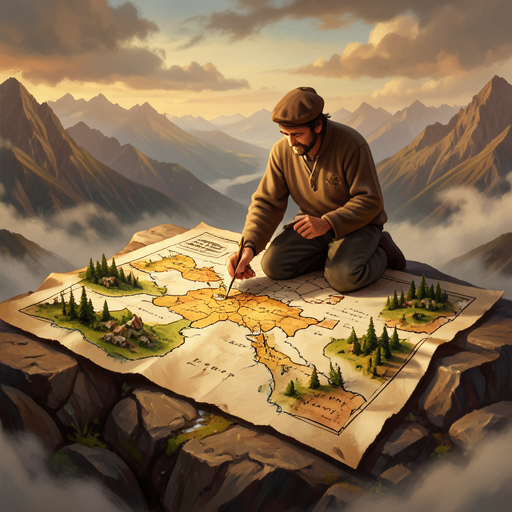
The Cartographer
"You don't explore for the thrill. You explore so the next person doesn't get lost."
You are the Explorer who explores slowly, carefully, and analytically. Where other Explorers rush into the unknown, you walk. You observe. You document. You are not in a hurry because the point is not to get there first. The point is to understand the territory well enough that your map helps everyone who comes after you.
Your Phantom signal means you do this work invisibly. You are not the Explorer who plants a flag and takes a photo. You are the Explorer who comes back with a topographical survey that nobody asked for and everyone needs. Your contribution is the understanding, not the adventure. The adventure is just how you gather data.
The Prism lens makes you a natural pattern-recognizer. You do not just see the individual trees. You see the forest's drainage patterns, the relationship between the soil composition and the canopy height, the reason the deer trail curves where it does. Everything is data. Everything connects. And you have the patience (Kindle fuel) to sit with the data long enough to find the connections that a faster mind would miss.
Strengths
- You notice patterns that other people cannot see because they do not sit still long enough. Your combination of patience, observation, and analytical thinking produces insights that feel obvious once you explain them and invisible before you do.
- You make the unfamiliar navigable. Your instinct is not just to explore but to translate what you find into something other people can use. The map is not for you. You already know the way. The map is for everyone else.
- Your depth of observation makes you an exceptional listener. You do not just hear what people say. You hear the patterns in what they say, the recurring themes, the things they emphasize and the things they avoid. You map conversations the way you map territories.
- You are comfortable in ambiguity for extended periods. Where Storm types need resolution quickly, you can hold an unresolved question for months, turning it over, adding data, refining your model. The answer comes when it is ready. You do not rush it.
Blind Spots
- You sometimes map instead of moving. The territory is well understood. The survey is complete. And yet you are still observing, still refining, still adding one more data point. At some point, the map is done and the journey needs to begin. You struggle with that transition.
- Your invisibility means your maps sometimes never reach the people who need them. You built the understanding. You wrote it down. You filed it... somewhere. The insight exists but the distribution channel does not. A Beacon partner would solve this.
- Your slow, patient exploration can look like indecision to people who operate on Storm fuel. You are not indecisive. You are thorough. But the distinction is lost on anyone counting the minutes.
In the Wild
You are the friend who returns from vacation with observations that nobody else would make. Everyone else has photos of landmarks. You noticed that the city changes character on the east side of the river, that the signage switched languages at a specific intersection, and that the restaurant prices drop by 30% two blocks from the tourist center. You noticed the SYSTEM. Everyone else noticed the sights.
Compatible Types
Their drive and visibility give your observations a megaphone and a purpose. You map it. They act on it. Together you cover observation and execution with no gap in between.
Their Storm intensity brings you raw experiences that your patient analysis turns into knowledge. They rush forward. You walk behind and understand why the ground shaped the path it did.
You both think in systems, but you observe systems while they build them. Together you create things that are both structurally sound and deeply informed by the territory they serve.