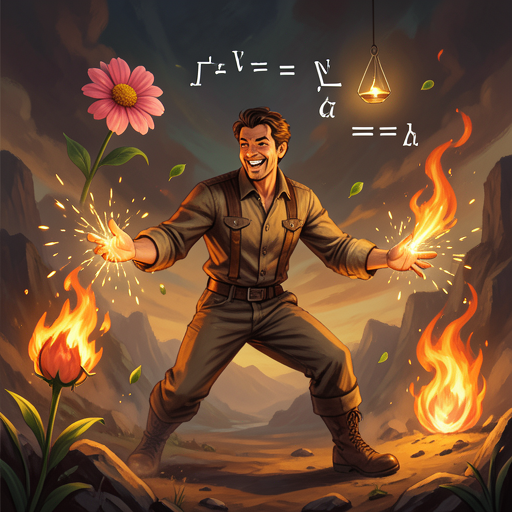
The Crucible
"You walk into stable rooms and stable rooms stop being stable. This is not a warning. It's a gift."
You are the human equivalent of a chemical reaction. Things happen around you. Not because you planned them -- you are an Explorer, not an Architect -- but because your energy, your visibility, and your analytical mind create conditions where things CANNOT stay still. You walk into a stable situation and by the time you leave, it has either leveled up or caught fire. Usually both.
Your Beacon signal means everyone sees it happening. You are not sneaking around. You are right there, loud and curious and asking the question that nobody else was brave enough to ask. "But WHY do we do it this way?" is your signature move. You do not accept "because that is how it is done." You accept "because here is the evidence that this method works." And if the evidence is not there, you start experimenting.
The Prism lens means your chaos is analytical. You are not random. You are systematic about your randomness. You test things. You observe the results. You adjust and test again. Other people see a tornado. You see a controlled experiment with a larger blast radius than intended. The distinction matters to you, even if it does not matter to the people picking up the debris.
Strengths
- You ask the questions that unlock entire rooms. The question nobody else would ask is the one that matters, and you ask it casually, like it is obvious, because to you it IS obvious.
- You learn faster than almost anyone because you learn by doing and you DO a lot. Your Explorer nature means you try things. Your Prism lens means you actually process what happens when you try them. Most people either experiment without learning or learn without experimenting. You do both simultaneously.
- Your energy is activating. People who spend time around you start doing things they have been putting off. Not because you told them to. Because your motion is contagious.
- You connect ideas from completely unrelated domains because you have BEEN in completely unrelated domains. The insight from your cooking phase shows up in your management approach. The thing you learned about motorcycles applies to the software problem. Your breadth IS your depth.
Blind Spots
- You leave a trail of started-and-abandoned projects that would make a Kindle type physically ill. You are not irresponsible. You are genuinely done once the interesting part is over. The problem is that other people were counting on the boring part getting finished too.
- Your visible, energetic approach means you sometimes create urgency where none exists. Not every room needs to be catalyzed. Some situations are stable because stable is correct. Your instinct to shake things up can disrupt systems that were working fine.
- You sometimes mistake your excitement for evidence. The Prism lens helps -- you DO check -- but your Storm fuel can outrun your analytical framework. You believe it is true because it FEELS exciting, and then you build the evidence to match. Watch for this.
In the Wild
You are the friend who texts the group chat at 2 AM with "okay hear me out" followed by an idea so ambitious it is either genius or delusional, and nobody can tell which until you have already tried it. You tried it. It was genius. Next week it will be a different genius idea. The first one is already abandoned. It served its purpose.
Compatible Types
They take your explosions and channel them into systems that last. You generate the energy. They build the infrastructure. Together you create things that are both exciting and durable, which should not be possible.
Their deep patience absorbs your frantic energy and reflects back the parts that actually matter. They are your filter. You need a filter.
You share the Beacon visibility and analytical lens, but their Kindle patience tempers your Storm intensity. They are the slow version of you. Together you cover both speeds.